영어 원문 보기
This Is What You Get for Second Class on a Chinese Bullet Train
Second Class on China's Bullet Train: Seats, Comfort, Cost
What is it really like to travel on a high-speed bullet train in China? This time, I'm taking you inside second class to show you what the experience looks like, from the seats and comfort to the overall convenience of travelling by train in China.
China's high-speed rail network makes travelling...
What is it really like to travel on a high-speed bullet train in China? This time, I'm taking you inside second class to show you what the experience looks like, from the seats and comfort to the overall convenience of travelling by train in China.
China's high-speed rail network makes travelling across the country incredibly convenient and affordable. But how does second class compare to first class, and what do you actually get for your money?
Join me as I explore another side of everyday life in China and experience what it's like living in and travelling around China.
Lizzy hops aboard China's iconic high-speed rail and gives us a real look at second class—no filters, no overly polished travel clichés. From seat dimensions to the sheer ease of moving across the country, she breaks down exactly what your money buys and how the experience compares to first class. It's a down-to-earth, fascinating glimpse into everyday Chinese travel.
What is it really like to travel on a high-speed bullet train in China? This time, I'm taking you inside second class to show you what the experience looks like, from the seats and comfort to the overall convenience of travelling by train in China.
China's high-speed rail network makes travelling across the country incredibly convenient and affordable. But how does second class compare to first class, and what do you actually get for your money?
Join me as I explore another side of everyday life in China and experience what it's like living in and travelling around China.
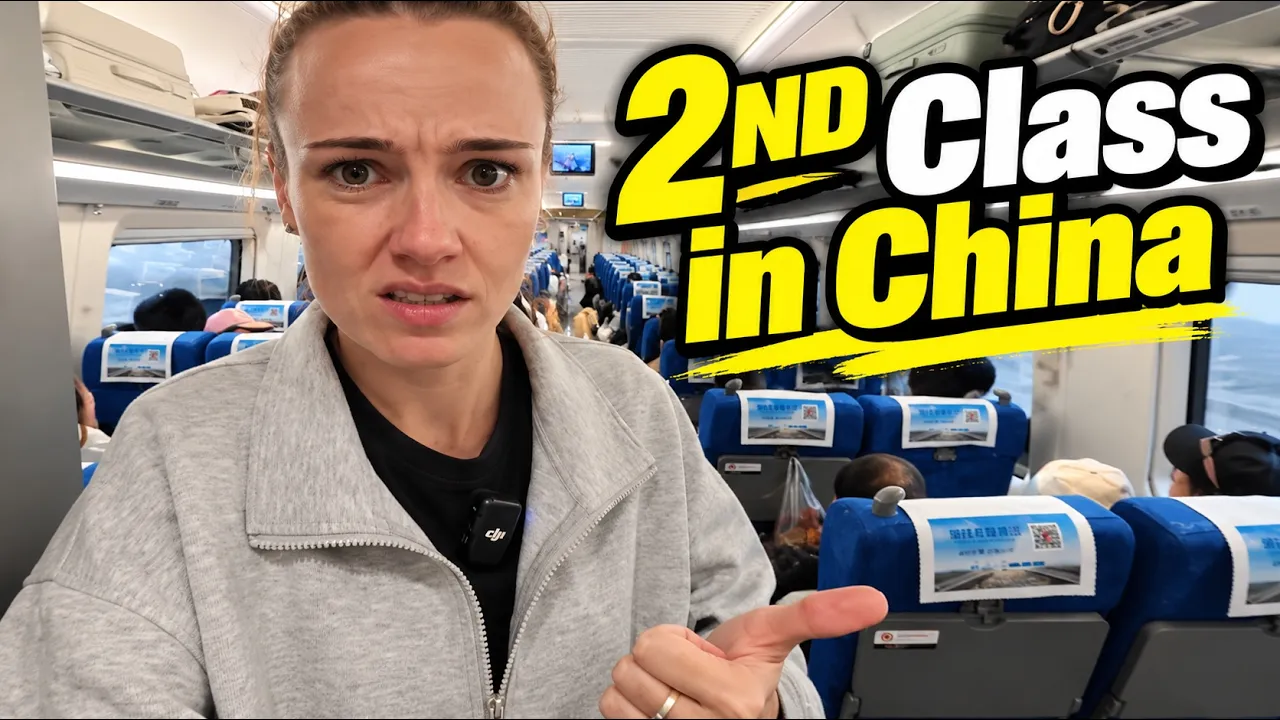
The creator opens by saying most YouTube videos show China's luxury first and business class train seats, but she wants to show how millions of ordinary people travel every day. She is not in Beijing or Shanghai but in a much smaller city, which some would call a village, and even there she can take a high-speed train. At the station she has passed the security check and shows the waiting area with restaurants, a smoking area, drinking water and convenience stores. Her train leaves at 7:00; she arrived at 6:30 for filming but usually comes around 6:45, because unlike an airport there is no queue to check in and no need to arrive 2 hours early. She describes a trip the day before from Jiaxing, an area with many factories, to Hangzhou, a big city: just over 20 minutes by high-speed train for 40 RMB, while a car takes around an hour and 20 minutes for 84 km. She stresses that price matters as much as speed, and that the network of tens of thousands of kilometres links not only Beijing, Shanghai and Shenzhen but many small stations like hers. On board she shows the hot water point, clean floors, a quiet carriage and racks that take big luggage. The 5G connection lets her upload YouTube videos while the train runs around 300 km per hour (up to 350 km per hour); passengers scroll WeChat and Chinese TikTok, watch TV or sleep because the ride is smooth. The bathroom has a door that opens with a button, a sink, a western toilet and a diaper changing table; she notes all train toilets are clean but not all are this spacious. A food trolley offers snacks, fruit, drinks and Starbucks coffee, and on some trains you can order Meituan, which she compares to Uber Eats; a friend once had KFC delivered to the train. She praises how stations and transport connect, contrasts this with expensive cars and weak public transport in America, and lists high-speed trains, share bikes, buses, DiDi and taxis at affordable prices. After arriving she says second class is comfortable, practical and more than good enough, though some may pay extra for more space or quiet on longer journeys.
Lizzy, who has lived in China for 8 years, skips the luxury seats and takes an ordinary second class high-speed train from a small city station. She shows the waiting area after security, with restaurants, convenience stores and drinking water, and explains there is no airport-style check-in or need to arrive 2 hours early. A trip from Jiaxing to Hangzhou the day before took just over 20 minutes and cost 40 RMB, versus around an hour and 20 minutes by car. On board she shows the hot water point, clean quiet carriages, space for big luggage, 5G at around 300 km per hour, and a spacious bathroom with a western toilet and diaper changing table. Snacks, fruit, drinks and Starbucks coffee are sold on board, and some trains take Meituan food delivery. Her verdict: second class is more than enough.
An ordinary second class high-speed train ride in China: easy station boarding, clean quiet carriages, luggage space, 5G, a spacious bathroom and food on board.
Second Class on a China High-Speed Train: Seats, Food and Toilets
1:26 Boarding a high-speed train is not like flying: there is no check-in queue and no need to arrive 2 hours early. Pass the security check, wait upstairs and go through the ticket gate shortly before departure.
1:16 After security the station waiting area has restaurants, convenience stores, drinking water and a smoking area, so you can buy food and drinks before you board.
1:48 For short hops the train beats the car: Jiaxing to Hangzhou took just over 20 minutes and cost 40 RMB, while driving the 84 km takes around an hour and 20 minutes.
3:29 Second class carriages even have a place for hot water, so you can get some hot water on board; the floors are clean and the carriage is quiet, which makes a long ride comfortable.
3:40 There is plenty of luggage space, and even big suitcases fit in the storage area, so you do not need to pay for a higher class just to carry large bags.
3:48 The trains have 5G coverage good enough to upload videos while travelling at around 300 km per hour, so you can work or stay online for the whole trip.
5:24 Train toilets are always clean and have a western toilet, but not every train bathroom is as spacious as the newest ones; some also have a diaper changing table.
5:41 A food service on board sells snacks, fruit, drinks and even Starbucks coffee, so you can buy something to eat without leaving your seat.
5:54 On some trains you can order food through Meituan, an app like Uber Eats, and have it delivered to the train; a friend of the creator once got KFC this way.
9:46 For visitors to China, second class is more than enough: it is comfortable, practical and smooth. Pay extra only if you want more space or quiet on a longer journey.
0:01 Why ride second class, not luxury
0:24 Starting from a small city station
1:09 Station waiting area after security
1:48 Jiaxing to Hangzhou in 20 minutes
2:19 How far the rail network reaches
3:29 Inside the second class carriage
3:48 5G and passengers on their phones
4:43 Touring the spacious train bathroom
5:41 Snacks, Starbucks and Meituan delivery
6:40 Affordable public transport in China
7:55 The train sets off smoothly
8:37 Verdict: second class is enough
China high-speed trainsecond class train Chinabullet trainJiaxingHangzhouZhejiangChina train travelMeituan5GChina public transporttrain station ChinaHow early do I need to arrive for a high-speed train in China?
The creator usually arrives around 6:45 for a 7:00 train. There is no check-in like at an airport, so you do not need to be there 2 hours early; you pass security and go through the ticket gate.
How long does the train take from Jiaxing to Hangzhou and how much does it cost?
Just over 20 minutes and 40 RMB by high-speed train, compared with around an hour and 20 minutes by car for the 84 km.
Is there space for big suitcases in second class?
Yes. The carriage has luggage racks and a storage area where even big suitcases can be stored.
Is there internet on Chinese high-speed trains?
The creator had 5G on board and could upload YouTube videos while the train ran at around 300 km per hour.
Can I get hot water on the train?
Yes, the carriage has a hot water point.
What are the toilets like on a Chinese high-speed train?
They are always clean and have a western toilet. The one shown had a button-operated door, a sink and a diaper changing table, but not every train bathroom is that spacious.
Can I buy food on a high-speed train in China?
Yes. Snacks, fruit, drinks and Starbucks coffee are sold on board, and on some trains you can order delivery through Meituan; a friend of the creator once had KFC delivered.
How fast do Chinese high-speed trains go?
Around 300 km per hour, and they can go up to 350 km per hour.
Is second class good enough for foreign visitors?
The creator, who has lived in China for 8 years, says second class is comfortable, practical and more than enough; some people pay extra for more space or quiet on longer trips.