Ver el original en inglés
Ningbo Metro: Way Out West (end of line 4)
Ningbo Metro Line 4 to the Western Terminus
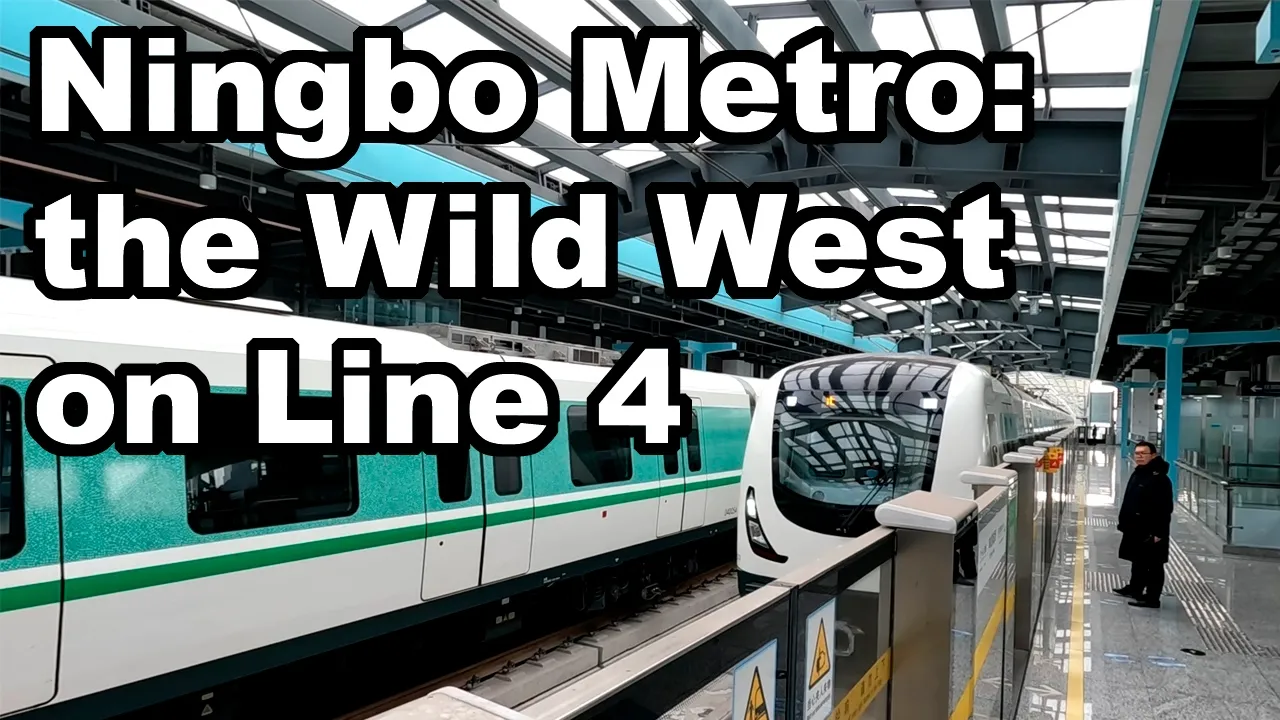
Join me on a trip on metro lines 8 and then 4 when I travel all the way to the end of line 4 in the west of Ningbo.
Ningbo Rail Transit, also known as the Ningbo Metro, is a rapid transit system serving the city of Ningbo, Zhejiang and its suburbs. Six metro lines are being built inside the urban...
Join me on a trip on metro lines 8 and then 4 when I travel all the way to the end of line 4 in the west of Ningbo.
Ningbo Rail Transit, also known as the Ningbo Metro, is a rapid transit system serving the city of Ningbo, Zhejiang and its suburbs. Six metro lines are being built inside the urban area of Ningbo, serving Haishu, Jiangbei, Zhenhai, Beilun and Yinzhou. The first phase of Line 1 started construction in June 2009 and began to service the public on May 30, 2014. Line 2 began service on September 26, 2015.
Ningbo Rail Transit is the second rapid transit system put into service in Zhejiang Province, after Hangzhou Metro.
Ningbo;
Ningbo is a sub-provincial city in northeast Zhejiang province, People's Republic of China. It comprises six urban districts, two satellite county-level cities, and two rural counties, including several islands in Hangzhou Bay and the East China Sea. Ningbo is the southern economic center of the Yangtze Delta megalopolis. The port of Ningbo–Zhoushan, spread across several locations, is the world's busiest port by cargo tonnage and world's third-busiest container port since 2010.
Ningbo is the core city and center of the Ningbo Metropolitan Area. To the north, Hangzhou Bay separates Ningbo from Shanghai; to the east lies Zhoushan in the East China Sea; on the west and south, Ningbo borders Shaoxing and Taizhou respectively. As of the 2020 Chinese national census the entire administrated area of Ningbo City had a population of 9.4 million (9,404,283).
Ningbo is one of the 15 sub-provincial cities in China, and is one of the five separate state-planning cities in China (the other four being Dalian, Qingdao, Xiamen, and Shenzhen), with the municipality possessing a separate state-planning status in many economic departments, rather than being governed by Zhejiang Province. Therefore, Ningbo has provincial-level autonomy in making economic and financial policies.
As a city with rich culture and a long history dating back to the Jingtou Mountain Culture in 6300 BC and the Hemudu culture in 4800 BC, Ningbo was awarded "City of Culture in East Asia" by the governments of China, Japan, and Korea in 2016. From 1842, Ningbo was one of the first five treaty ports opened up to the West. Ningbo is one of the top 200 cities in the world by scientific research as tracked by the Nature Index.
Tim Chambers rides Ningbo Metro lines 8 and 4 to the western end of the network. At his local station, he buys a single-trip ticket because his multi-use ticket has run out of balance. He transfers at Southern Business District and Hongda Road, then continues on line 4. The route moves above ground and passes road construction, hills and countryside. Tim notes that line 8 is driverless while line 4 has a driver. At the end of the line, announced as Cicheng station, he inserts his single-trip ticket at the exit and looks for exit B1.
Join me on a trip on metro lines 8 and then 4 when I travel all the way to the end of line 4 in the west of Ningbo.
Ningbo Rail Transit, also known as the Ningbo Metro, is a rapid transit system serving the city of Ningbo, Zhejiang and its suburbs. Six metro lines are being built inside the urban area of Ningbo, serving Haishu, Jiangbei, Zhenhai, Beilun and Yinzhou. The first phase of Line 1 started construction in June 2009 and began to service the public on May 30, 2014. Line 2 began service on September 26, 2015.
Ningbo Rail Transit is the second rapid transit system put into service in Zhejiang Province, after Hangzhou Metro.
Ningbo;
Ningbo is a sub-provincial city in northeast Zhejiang province, People's Republic of China. It comprises six urban districts, two satellite county-level cities, and two rural counties, including several islands in Hangzhou Bay and the East China Sea. Ningbo is the southern economic center of the Yangtze Delta megalopolis. The port of Ningbo–Zhoushan, spread across several locations, is the world's busiest port by cargo tonnage and world's third-busiest container port since 2010.
Ningbo is the core city and center of the Ningbo Metropolitan Area. To the north, Hangzhou Bay separates Ningbo from Shanghai; to the east lies Zhoushan in the East China Sea; on the west and south, Ningbo borders Shaoxing and Taizhou respectively. As of the 2020 Chinese national census the entire administrated area of Ningbo City had a population of 9.4 million (9,404,283).
Ningbo is one of the 15 sub-provincial cities in China, and is one of the five separate state-planning cities in China (the other four being Dalian, Qingdao, Xiamen, and Shenzhen), with the municipality possessing a separate state-planning status in many economic departments, rather than being governed by Zhejiang Province. Therefore, Ningbo has provincial-level autonomy in making economic and financial policies.
As a city with rich culture and a long history dating back to the Jingtou Mountain Culture in 6300 BC and the Hemudu culture in 4800 BC, Ningbo was awarded "City of Culture in East Asia" by the governments of China, Japan, and Korea in 2016. From 1842, Ningbo was one of the first five treaty ports opened up to the West. Ningbo is one of the top 200 cities in the world by scientific research as tracked by the Nature Index.
Tim Chambers begins at a local station in Ningbo and says he will travel west on the metro. His multi-use ticket has run out of money, so he buys a single-trip ticket. He notices people rushing for a train and says the next one is six minutes later. He transfers through Southern Business District and then Hongda Road, correcting himself from line 3 to line 4 after initially getting confused. He comments that line 8 is driverless, but later points out a driver on line 4. The train travels above ground and passes construction, roadways, hills and countryside on the western outskirts. Tim says there are seven stops to Qizhong West, though the station name is not clear in the transcript. He reaches the end of line 4, identifies the terminal as Cicheng station, inserts his single-trip ticket at the exit gate and looks for exit B1. He summarizes the route as line 8 followed by line 4 and shows construction sites at the end of the line. The video description supplies Ningbo and Zhejiang; several other spoken station names are unclear and are not normalized here.
Tim Chambers rides Ningbo Metro lines 8 and 4 to the western end of the network. At his local station, he buys a single-trip ticket because his multi-use ticket has run out of balance. He transfers at Southern Business District and Hongda Road, then continues on line 4. The route moves above ground and passes road construction, hills and countryside. Tim notes that line 8 is driverless while line 4 has a driver. At the end of the line, announced as Cicheng station, he inserts his single-trip ticket at the exit and looks for exit B1.
Tim rides Ningbo Metro lines 8 and 4 west to Cicheng, showing the transfers, overground views and countryside at the end of the line.
Ningbo Metro Line 4 to the Western Terminus
0:32 Tim says his multi-use ticket had run out of money, so he bought a single-trip ticket before boarding. The clip does not show how to add balance or compare other ticket options.
0:45 Tim says he caught a train just before the next one, which he says would arrive six minutes later. That is the interval he observed during this trip, not a full or current timetable.
1:45 Tim says line 8 is driverless, then later points out a driver on line 4. This describes the two lines he rides in the video; it is a reminder that the operating setup can differ by line.
2:24 When the train is above ground, Tim says he needs to check that he is on the right side. The clip shows his concern at this transfer and does not provide a general station map.
5:05 At the terminal, Tim inserts his single-trip ticket at the exit gate and looks for exit B1. This is the exit process shown for his ride; the video does not describe other ticket types.
0:00 Starting a westbound metro trip
0:32 Buying a single-trip ticket
1:07 Transferring through Ningbo
1:23 Southern Business District station
2:13 Changing to line 4
2:24 The train goes above ground
3:00 Construction along the route
3:40 Hills near Changxing Road
4:06 Countryside west of Ningbo
4:48 Reaching Cicheng terminal
5:05 Exiting with a single-trip ticket
5:19 Recapping the line 8 and 4 route
chinatrainpublic transportrailrailwaytrain stationtraveltransportningbozhejiangmetrochina metrometro systemssubwaychina subwayunncunnc ningboningbo metrochina metro line 8china metro developmentchina metro growthchina growthchina rail growthbuildingchina tariffchina tariffsmetro expansionningbo line 4west ningboningbo westWhich Ningbo Metro lines does Tim ride?
He starts on line 8 and transfers to line 4, correcting an earlier mention of line 3.
Where does the line 4 train terminate in the video?
Tim identifies the terminal as Cicheng station.
What does Tim see on the western part of the ride?
He shows construction sites, hills and countryside outside the urban area.
How does Tim leave the terminal?
He inserts his single-trip ticket at the exit gate and looks for exit B1.
Are all the trains shown driverless?
No. Tim says line 8 is driverless, while he sees a driver on line 4.