查看英文原文(English)
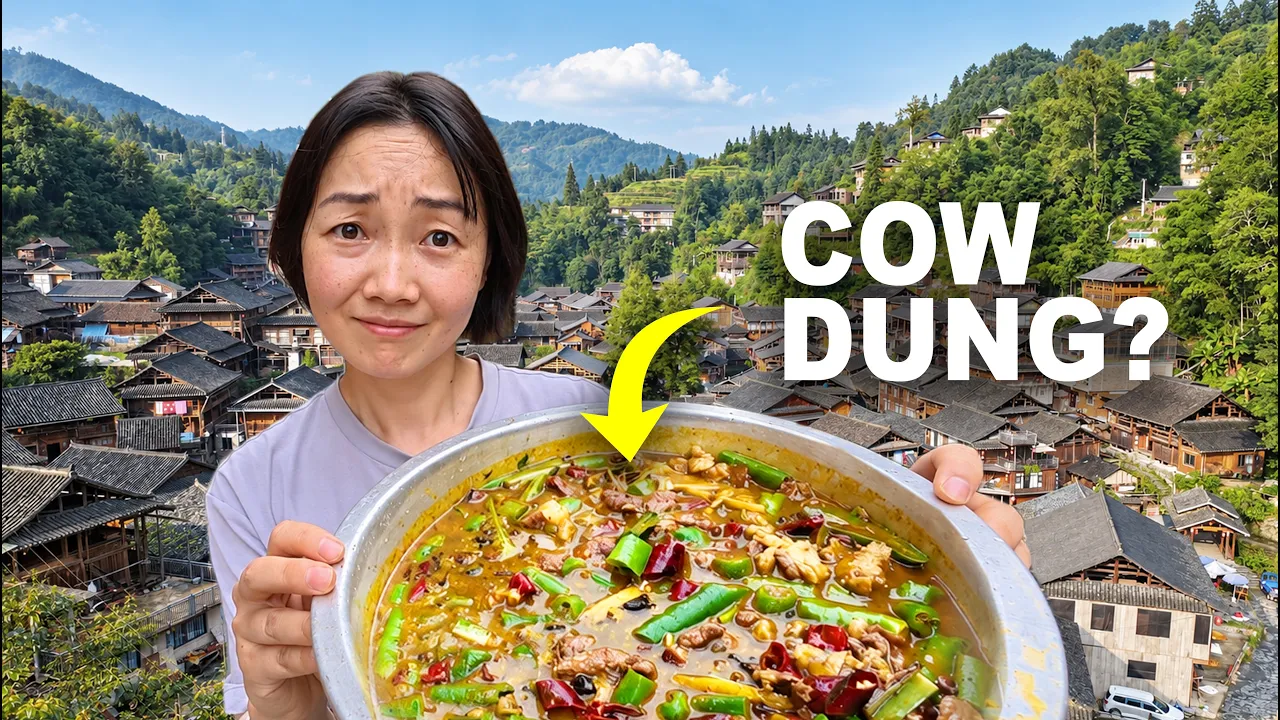
Trying China's Most Bizarre Cow P**p Hotpot 🐮
Trying Bizarre Cow Dung Hotpot in a Guizhou Dong Village
We tried one of China’s most unusual foods: cow dung hotpot! And yes, there’s a reason it’s called that. It’s made with the partially digested contents of a cow’s stomach, which are cooked in a hotpot. It’s particularly well known among the Dong people in Guizhou.
We travelled to a remote Dong...
We tried one of China's most unusual foods: cow dung hotpot! And yes, there's a reason it's called that. It's made with the partially digested contents of a cow's stomach, which are cooked in a hotpot. It's particularly well known among the Dong people in Guizhou. We travelled to a remote Dong village to try this unique dish. But that wasn't all! The Dong people are also famous for their traditional singing, and we got to witness this beautiful tradition in one of their villages. 🇨🇳
Experience the bizarre yet fascinating world of Chinese cuisine as we venture into a remote Dong village to taste the infamous cow dung hotpot. Witness the rich cultural traditions of the Dong people, from their ancient singing to their unique culinary heritage.
We tried one of China's most unusual foods: cow dung hotpot! And yes, there's a reason it's called that. It's made with the partially digested contents of a cow's stomach, which are cooked in a hotpot. It's particularly well known among the Dong people in Guizhou. We travelled to a remote Dong village to try this unique dish. But that wasn't all! The Dong people are also famous for their traditional singing, and we got to witness this beautiful tradition in one of their villages. 🇨🇳
The creators open in Zaidong Dong Village, Guizhou, explaining that today's star dish is niubie hot pot, literally 'cow poop' hot pot. Along a street in Rongjiang almost every restaurant specialises in it. In one kitchen staff clean and cut beef tripe, which is blanched in boiling water for about three minutes, never ten, or it turns tough, then mixed with oil and soy sauce. The broth comes from a plastic bag of undigested grass from the cow's first stomach; locals call it hundred-herb soup because cows graze herbs on the mountains. Restaurants do not sell the juice alone, so the couple buys beef at the market and gets a bag of niubie for free. With Brother Luo of Zaidong they squeeze the grass by hand (no water added); the smell is strong and stomach-like. Villagers say it has always been made this way, children dislike it at first, and a cow is slaughtered for festivals such as the Dragon Boat Festival, the Sixth of June and eating new rice, and for weddings. Cooking uses a big firewood pot, with chicken and braised pork as backup dishes. Walking the village they see households dyeing their own cloth with dye made from banlangen, giving a shiny indigo fabric, and learn singing practice starts at eight thirty at the drum tower. Traditional wooden stilt houses use no nails or screws, and the drum tower marks the village centre and social hub. The hot pot is seasoned with Sichuan pepper, dried chillies, ginger and garlic before the green broth goes in. At the long table the tripe tastes grassy and a little bitter; the main hurdle is psychological. In Congjiang people eat it raw. Villagers talk about working in Zhejiang and Guangdong, singing since childhood and antiphonal love songs. At night about a hundred singers gather around eight or nine p.m. after farm work; Zaidong is described as the birthplace of the Dong Grand Song in Rongjiang, where about ninety percent of people can sing.
A travel couple visits Rongjiang and Zaidong Dong Village in Guizhou's Qiandongnan Miao and Dong Autonomous Prefecture to try niubie hot pot, the local 'cow dung' hotpot. In a Rongjiang restaurant kitchen they learn the broth is made from partially digested grass from a cow's first stomach, locally called hundred-herb soup, while tripe is blanched for just a few minutes. They squeeze the niubie by hand, walk the village to see families dyeing cloth with banlangen indigo, nail-free wooden stilt houses and the drum tower square, then share a firewood-cooked feast with villagers. At night they watch the village choir practise the Dong Grand Song under the drum tower.
Trying niubie (cow dung) hot pot in a Dong village in Rongjiang, Guizhou, plus indigo dyeing, stilt houses and Dong Grand Song practice.
Niubie Hot Pot and Dong Grand Song in Rongjiang, Guizhou
1:17 To try niubie hot pot, head to the restaurant street in Rongjiang, where almost every restaurant specialises in this local Dong and Miao dish from Qiandongnan in Guizhou.
1:43 Beef tripe for niubie hot pot only needs to be blanched in boiling water for about three minutes; cook it too long and it gets tough, then mix with oil and soy sauce.
2:51 Niubie is not actually cow dung: it is partially digested grass from the cow's first stomach mixed with stomach juice, and locals call the broth hundred-herb soup.
3:12 Restaurants do not sell the niubie juice on its own, so if you want to cook it yourself, buy beef at the market; the creators got a bag of niubie thrown in for free.
6:04 Niubie hot pot is a festival and wedding dish in Dong villages, when families slaughter a cow, for example at the Dragon Boat Festival and eating new rice.
10:25 In Zaidong Dong Village the villagers practise singing at the drum tower at night, around eight thirty, and visitors can walk over and watch the choir.
15:58 If you are nervous about niubie, the cooked broth loses most of its smell and tastes grassy and a little bitter; the biggest barrier is psychological, not the flavour.
16:58 In Congjiang niubie is eaten differently, with raw beef dipped in raw niubie broth, which even Rongjiang villagers find hard to accept, so check how it is served.
25:00 Bring a torch if you visit the Dong village singing practice at night, because there is no light on the street and villagers arrive with torches.
0:00 Intro
1:05 Getting the Ingredients
3:52 Squeezing the niubie grass broth
6:30 Dong People's Village
7:25 Indigo cloth dyeing with banlangen
11:07 Nail-free stilt houses and drum tower
13:17 Eating the Cow Dung Hotpot
22:00 Dong People's Singing Culture
0:00 Intro
1:05 Getting the Ingredients
6:30 Dong People's Village
13:17 Eating the Cow Dung Hotpot
22:00 Dong People's Singing Culture
chinaunseen chinachinese foodchina travel vlogchinese culturechinese peopletravel in chinachina attractionsmainland chinatraditional chinatraditional culturerural chinatravel documentarytraveltravel vlogchina dronedong peopledong choirchinese choircow dunghotpotcow dung hotpotchinese hot pot牛瘪牛瘪火锅guizhouguizhou provinceguizhou traveldong ethnic groupcow stomachcow hotpothot potcow dung hot potWhat is niubie hot pot made from?
The broth uses partially digested grass from a cow's first stomach mixed with stomach juice, squeezed out by hand without adding water. Locals call it hundred-herb soup because cows graze mountain herbs. Beef and tripe are cooked in it.
Where can I eat niubie hot pot in Guizhou?
On a street in Rongjiang, in Qiandongnan Miao and Dong Autonomous Prefecture, almost every restaurant specialises in niubie hot pot. The creators also ate it at a village feast in Zaidong Dong Village.
Does niubie hot pot smell bad?
The raw niubie smells strongly of stomach contents, but after cooking with Sichuan pepper, dried chillies, ginger and garlic the smell almost disappears; it tastes grassy and slightly bitter, and one diner compared it to durian.
When do Dong people eat niubie hot pot?
Traditionally at festivals and weddings, when a cow is slaughtered, such as the Dragon Boat Festival, the Sixth of June and eating new rice. Villagers say that now they can eat it whenever they want.
Is niubie eaten raw?
In Congjiang, villagers said people eat raw beef dipped in raw niubie broth. In Rongjiang it is cooked as a hot pot.
When can I watch Dong Grand Song practice in Zaidong?
Villagers practise under the drum tower at night, scheduled for eight thirty but starting nearer nine, after farm work and dinner. Around a hundred singers were expected that night.
How are Dong houses built?
Traditional Dong houses are wooden stilt houses on foundation stones, with pieces fitted into each other and no nails or screws; even new houses in the village are built this way.
How do Dong villagers dye their cloth?
They make their own indigo dye from banlangen, a plant that turns into dark mud-like dye; the cloth is dipped, dried and becomes a shiny blue fabric they sew into their own clothes.